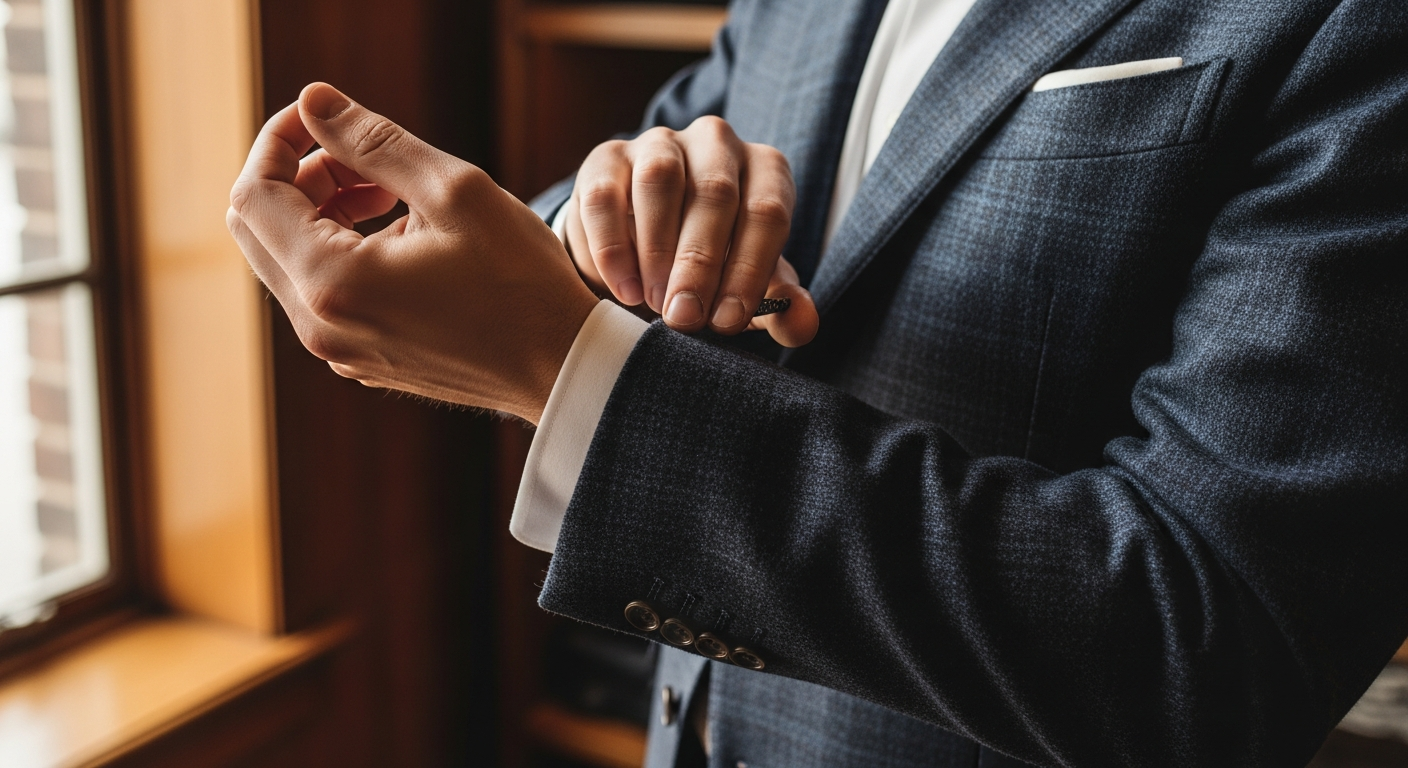
The In-Between: How to Dress Well While Your Body Is Changing
Weight loss changes everything in your closet. Here's how to stay sharp through every stage of the transformation, without waiting for the finish line.
There's a particular kind of frustration that doesn't get talked about much. You've done the hard thing: changed your habits, shown up for yourself, started becoming the version of you that you've been thinking about for a while. And then one morning you pull on your best trousers, cinch the belt a notch tighter than usual, and catch your reflection. You look like a boy wearing his father's clothes.
The weight is coming off. That's the good news. The bad news is that everything in your closet was built for a man who no longer exists.
This is a moment we see more often than you'd think. A gentleman walks through our door, sometimes a little sheepish, and says some version of the same thing: I've lost weight, nothing fits, and I don't know where to start. He's caught between two wardrobes: the one that's too big and the one he hasn't earned yet. He's in the in-between.
Here's what we tell him.
Dress the Man in the Mirror, Not the Man on the Calendar
The most common mistake men make during weight loss is deferring. They tell themselves they'll buy good clothes when they reach their goal weight. In the meantime, they swim in oversized shirts and cinch their trousers with a belt doing work it was never designed to do. They look, frankly, like they've given up, which is the precise opposite of what's actually happening.
You deserve to look sharp at every stage of this process. Not just at the finish line. The discipline you're bringing to your health deserves a wardrobe that reflects it. When your clothes fit well, you carry yourself differently. People notice. You notice. And that feedback loop (looking better, feeling better, staying motivated) is worth more than whatever you'd save by waiting.
This doesn't mean spending recklessly. It means spending strategically.
The Tailor Is Your Best Friend (Within Reason)
Before you replace a single garment, take your best pieces to a skilled tailor. A good alteration can buy you months of wear from clothes you already own and love.
Here's what most men don't realize: trousers are the easiest and most cost-effective garments to take in. A waistband can be brought in an inch or two without disturbing the overall proportions of the garment. Shirts can be darted at the sides or slimmed through the torso for relatively little cost. Sport coats and blazers can be adjusted at the side seams and, if necessary, slightly through the back.
But there are limits, and an honest tailor will tell you what they are. The general rule is that most garments can be taken in about two inches (roughly one full size) before the proportions begin to suffer. Beyond that, pockets drift out of position, lapels look too wide for the body, and shoulders sit where they shouldn't. A jacket that's been taken in three or four sizes doesn't look tailored. It looks wrong in ways most people can sense but can't articulate.
So the practical rule: if a garment is one size too large, alter it. If it's two or more sizes too large, let it go with gratitude for the service it gave you, and move on.
Invest Where Size Doesn't Matter
There's a category of clothing and accessories that will follow you through every stage of your transformation without ever needing to be replaced. These are your smartest purchases right now.
Shoes. Your feet are among the last places you'll notice weight loss. A pair of well-made leather shoes (a clean derby, a versatile Chelsea boot, a proper dress shoe) will serve you at 240 pounds and at 200 pounds. This is the place to invest in quality. A good shoe only gets better with age, and it anchors every outfit you put together during the transition.
Outerwear. A well-constructed overcoat or field jacket is designed with enough room to accommodate layers beneath it. Unless you're losing a dramatic amount of weight, your outerwear will likely carry you through. And a good coat makes everything underneath it look more intentional.
Accessories. A thoughtful watch, a quality leather belt (look for micro-adjustable styles with no fixed holes; they're a godsend during weight fluctuations), a cashmere scarf, a pocket square. These pieces telegraph care and attention regardless of how your trousers fit this month.
Knitwear. This is the unsung hero of the transitional wardrobe. A well-made merino or lambswool sweater in a classic gauge has natural give. It drapes over a range of body shapes without looking sloppy or tight. A crewneck sweater over a collared shirt is one of the most reliably sharp combinations in menswear, and it's remarkably forgiving through fifteen or twenty pounds of change. Look for quality knits from heritage mills; they hold their shape wash after wash. (For more on how layering works in our climate, see Spring Layers on Lake Superior.)
The Case for Strategic Layering
Layering isn't just for warmth. It's architecture.
During the in-between, layers give you control over your silhouette in ways that a single garment can't. A sport coat over a sweater over a shirt creates structure across the upper body. It draws the eye to the shoulders and chest (areas that tend to maintain their shape during weight loss) rather than the midsection, where most men lose volume first.
A cardigan under a blazer, for instance, fills out the chest and creates a clean, intentional line even if the blazer is slightly roomier than it should be. A vest, whether part of a three-piece suit or a casual quilted layer, defines the torso and adds visual weight where you want it. These aren't tricks. They're the same principles that well-dressed men have used for a century to present their best selves.
The key is fit at the outermost layer. If your jacket fits well at the shoulders and doesn't pull or bunch, most people will never notice that the shirt beneath it has a little extra room.
Hold the Big Investments
Here's where we'll give you advice that might seem counterintuitive coming from a haberdashery: if you're actively losing weight and haven't yet stabilized, this is not the time to commission a made-to-measure suit.
Custom tailoring is an investment in precision. A made-to-measure suit is cut to your exact measurements on a specific day. If those measurements are going to change meaningfully over the next three to six months, you're building on shifting ground. The suit will need alterations almost immediately, and while custom garments typically leave more inlay (extra fabric at the seams for future adjustment), even that generosity has limits.
Wait. Be patient. When your weight stabilizes (and you'll know, because you'll go a month or two without needing to tighten your belt again), that's when you walk in for a fitting. That's when you invest in the suit that will carry you through the next decade. The anticipation, honestly, is part of the reward. You've earned it. Let the moment be right. (And when that moment comes, here's what to expect at your first fitting.)
In the meantime, if you need a suit for a specific occasion (a wedding, an interview, a milestone), a good off-the-rack suit in your current size, properly altered, will serve you well. Spend modestly. Get it fitted. Look sharp. Move on.
The Transitional Capsule
If you're rebuilding from scratch, you don't need much. You need the right things.
A pair of dark, well-fitting trousers in a fabric with a touch of stretch. A pair of quality denim in a straight or slim cut, not rigid but structured enough to hold a crease. Two or three shirts in your current neck and chest size: one white, one light blue, one in a subtle pattern. A navy blazer that fits your shoulders today. Two sweaters: one crewneck, one quarter-zip or cardigan. A versatile pair of leather shoes.
That's a working wardrobe. It mixes and matches across casual and professional settings. Every piece can be altered once, replaced affordably if you outgrow it (or, rather, undergrow it), and none of it will embarrass you at a dinner, a meeting, or a Saturday afternoon.
The temptation is to buy cheap and disposable during the transition. Resist it. You don't need to buy expensive, but you should buy well-made. A fifty-dollar shirt that fits properly looks infinitely better than a two-hundred-dollar shirt that's three sizes too large. And well-made garments in classic cuts hold up to the tailor's needle: they can be taken in, adjusted, and refined in ways that flimsy construction can't survive.
The Deeper Thing
There's something we've noticed over 121 years of helping men get dressed. The moments when a man walks in needing new clothes are almost never just about clothes. They're about change. A new job. A wedding. A loss. A fresh start.
Weight loss is one of those thresholds. You're becoming someone different, not fundamentally, but in the way you move through the world, the way you feel when you stand up straight, the way you meet your own eyes in the mirror. Your wardrobe should honor that process, not lag behind it.
You don't have to figure this out alone. That's what we're here for. Come in. Tell us where you are and where you're headed. We'll pull a few things, talk through what makes sense, and make sure that the man in the mirror looks like the man you're becoming.
Not the man you were. Not the man you'll be someday. The man you are right now.
That man deserves to be well dressed.
The Columbia of Duluth has been outfitting gentlemen since 1905. To book a consultation, visit columbiaduluth.com/appointments or call (218) 722-3339.